VM0047 Appendix 1
Area-based performance method. Dynamic baseline derived from matched control plots — not an assumed counterfactual.
Methodology under VM0047 v1.1. Governance under Article 371A and a Village Project Management Committee elected by the community. Livelihoods anchored in the NABARD baseline. The numbers below are pre-validation targets and estimates — they will be validated by an accredited VVB as the project registers under VCS.
VM0047 Appendix 1 — the rigorous quantification approach Verra publishes for area-based reforestation. A baseline derived from matched control plots, not an assumed counterfactual.
Area-based performance method. Dynamic baseline derived from matched control plots — not an assumed counterfactual.
Plots span 1–30 years of Jhum fallow. SDM ≤ 0.25 matching discipline.
Sentinel-2 + Sentinel-1 SAR for cloud-penetration, custom canopy and stocking models trained on our own permanent sample plots, per-tree geotagging from year one.
Climate, Community & Biodiversity Standard v3.1 — alignment to CM2, CM4, and GL2.
One PSP per ~100 ha across both districts — DBH, height, species, health surveyed annually. Ground truth feeds every model upstream.
In-house canopy-cover and stocking-density models calibrated on our own ground plots, retrained at every measurement window. R² targets above 0.85 against AGB in this biome.
Sentinel-2 (~10 m optical) for canopy cover and NDVI; Sentinel-1 SAR for cloud-penetration and structural change; high-resolution commercial tasking on cohort-level audits.
Every sapling geotagged at planting with a photograph and a timestamp. Survival confirmed via change detection. Anomalies surfaced to the VVB evidence trail in near-real time.
The pipeline is open-source where the science permits and reproducible end to end. NDFI tracks degradation; NDVI tracks vigor; biomass is modelled per-species via Chapman-Richards growth and Chave 2014 allometry. Model outputs are auditable against the underlying ground plots — an investor or VVB can trace any number on this site back to a sample plot or a satellite scene.
The model accounts for five carbon pools per VM0047. The composition below is the pre-validation projection at project year forty, per hectare. Numbers are anchored to ISFR 2023 benchmarks for Nagaland forest types.
A managed plantation at 600–700 TPH stores roughly 172.07 tC/ha by year 40 — 631.5 tCO₂e/ha equivalent. Five pools, dominated by biomass and SOC.
Above-ground biomass
81.76 tC/ha · 48%
Below-ground biomass
26.41 tC/ha · 15%
Soil organic carbon
60.00 tC/ha · 35%
Litter
1.98 tC/ha · 1%
Deadwood
1.92 tC/ha · 1%
Total carbon at y40
172.1 tC/ha · 631.5 tCO₂e/ha
Between FSI Hill-Forest average (135.7 tC/ha) and FSI Very Dense Forest (187 tC/ha) — a defensible band for a managed native-species plantation.
Above-ground biomass and below-ground biomass follow Chapman-Richards growth × Chave 2014 allometry. Soil organic carbon is anchored to ISFR 2023 Nagaland gain rates. Litter and deadwood saturate against managed plantation slash. The full per-pool derivation, the species-mix calibration, and the carbon model itself are shared through the data room.
The species list was co-created with implementation partners and the village councils that enrolled. Communities choose the actual planting mix at site level — soil, slope, elevation, and household priorities all shape it. Targets across the four canopy layers are 35% pioneer, 35% midstory, 25% canopy, 5% special value.
Fast establishment, soil restoration, nitrogen fixation
Medicinal, multipurpose, ecosystem function
Long-lived structural canopy, premium timber
Cultural, medicinal, niche
Coffee, cardamom, pepper, and the orchard layer (banana, papaya, citrus, areca) sit alongside the restoration palette as intercrops in the agroforestry model — they are part of household income and the integrated farming concept, not part of the carbon-restoration species count.
The Indo-Burma hotspot supports a dense wildlife community that shrinks as canopy fragments. The species below are emblematic of the corridor we are reconnecting — some are named in our project documentation, others are well-documented in Nagaland and the adjacent Indo-Burma habitat. The camera-trap network that comes online in phase two records what is actually present plot by plot.
Buceros bicornis
Cultural keystone in Naga heritage. Disperses large-seeded canopy species across kilometres of forest — the project palette includes several it depends on.
Tragopan blythii
Nagaland's state bird. Ground-dwelling pheasant of mid-elevation montane forest. Habitat sensitive to canopy gaps and disturbance.
Hoolock hoolock
India's only ape. Strictly arboreal — requires continuous canopy across home ranges. The intact-forest corridor reconnection in Longleng is for it as much as anything.
Neofelis nebulosa
Cryptic mid-elevation predator of dense forest. Population recovery is tied directly to closed-canopy connectivity at the landscape scale.
Elephas maximus
Seasonal mover through Nagaland's hill forests. Functions as an ecosystem engineer — opens canopy gaps, disperses seeds, maintains forest mosaic.
Manis pentadactyla
Most-trafficked mammal in the world. Eats termites and ants. Survival in this region depends on intact ground-layer cover and on community-led patrols.
Spelaeornis chocolatinus
Endemic to the hills of Nagaland and the surrounding region. Rediscovered after a long gap; reliable indicator of dense undergrowth in mid-elevation forest.
Confirmed species are named in our project documentation and stakeholder consultations. Range species occur across Nagaland and adjacent Indo-Burma habitat that the project corridors are designed to reconnect — their presence per cohort village will be documented as the camera-trap network expands.
Day-to-day decisions sit with the elected VPMC. Annual oversight sits with the Village Council under customary law. Policy sits with the Annual Community Meeting, open to every enrolled household. The structure is set in the Carbon Rights Partnership Agreement.
Village Project Management Committee
Five to seven elected members, with at least one in three women, three-year terms. Manages the Community Fund, coordinates monitoring access, holds the first point of contact for grievances. Bye-laws within 90 days of agreement.
Traditional governance authority
Reviews the annual plan and budget, reviews VPMC performance, endorses enrollment, and retains review and override authority over VPMC decisions inconsistent with community welfare or customary governance.
Open to all enrolled members
Convened once a year, open to every enrolled community member. Sets allocation priorities, ratifies material amendments, elects the VPMC. Decisions by consensus, or — where consensus is not achievable — by majority of members present.
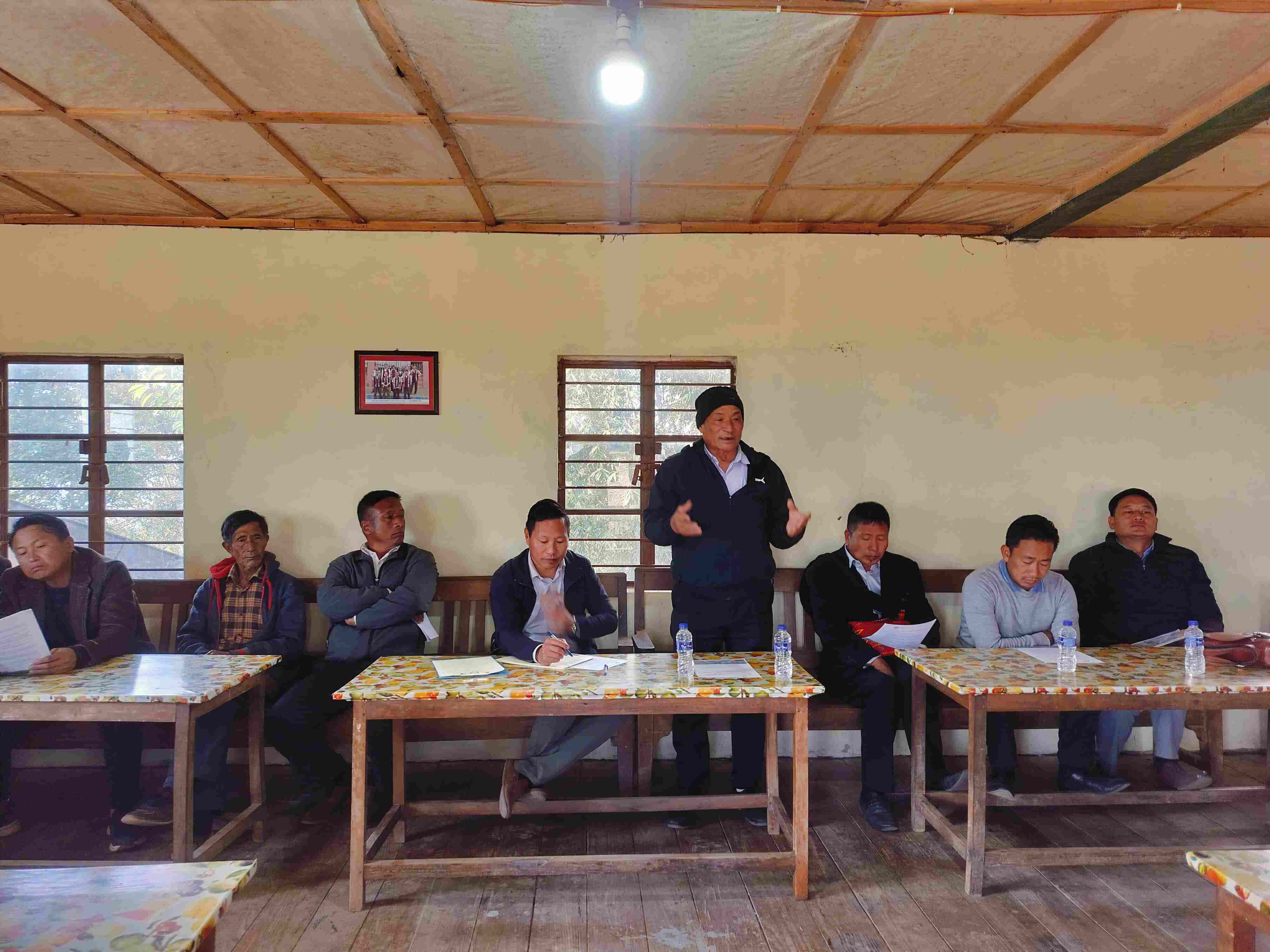
Tseminyu district, Nagaland · Forest Futures archive
50+
Local stakeholder consultations across Tseminyu and Longleng, preceding project initiation and FPIC documentation.
A Village Project Management Committee is constituted for each enrolled village within sixty days of the Effective Date.
Agricultural income is not replaced by carbon. It is strengthened — through agroforestry in Tseminyu, restoration-linked enterprise in Longleng, and a community fund directed by the community itself.
people across cohort villages
households participating directly
Largest per-household landholding of any Indian state
Monthly income
Rs. 12,363
Monthly surplus
Rs. 954
Annual surplus
Rs. 11,448
~US$120
The community-fund share, when it activates, is projected to add roughly ~1.5× of this annual surplus per participating household per year — supplemental income, not replacement. Enterprise pilots (coffee, terrace cultivation, fishery, orchards) are projected to lift a participating household’s livestock or coffee income by 2–6× against current state averages.
NABARD NAFIS 2021–22 · Nagaland
The project aligns with the Climate, Community & Biodiversity Standard v3.1 across CM2, CM4, and GL2.
Phase-based community-fund disbursement, livelihood pilots, women's representation in committee composition, demonstrated through annual community surveys.
Targeting Gold Level: at least half of the community fund directed to marginalised households, identified by the community itself, with auditable disbursement records.
Sixteen native species across four canopy layers, connectivity to adjacent intact-forest corridors, no IUCN Red-list species displaced, camera-trap network from phase two.
The community share of net cash flow grows in phases as the project matures. The structure is reviewed at every verification, with independent facilitation. Wages paid to community labour are project costs flowing to the community — they are never added to the headline community share.
The proponent absorbs establishment cost. Community wages flow from the first year as a project expense, before any revenue exists.
Carbon revenue activates. The community share of net cash flow opens at the first verification.
The community share of net cash flow grows as the project matures.
The community share reaches its long-term level. Reviewed at every verification.
Across the four phases, at least half of net cash flow flows to the community fund. The fund is administered by the VPMC and answers to the Annual Community Meeting; decisions on its use are made in assembly, in language, in person. Exact phase percentages sit in the Carbon Rights Partnership Agreement and are shared on access request.
We’ll curate the pack relevant to your role and send it via email — financial model, scenarios, benefit-sharing model, term sheet, and the legal agreements.